Over the past decade, the central question for insurance investors was where to find enough yield without taking too much risk. Today, that question appears incomplete. Yields are more compelling, but regulation more granular, reporting more demanding, and the opportunity set more complex. The challenge is no longer simply to add spread but also to decide which risks deserve capital, which structures genuinely improve the liability matching profile, and which apparent premiums survive a full accounting of liquidity, governance, and downside behavior.
We believe that shift should be welcomed as strategic asset allocation works simultaneously through several lenses: economic value, statutory capital, rating-agency treatment, accounting income, cash-flow matching, and operational capacity. Even the most attractive security in isolation can be wrong for a general account if it moves duration in the wrong direction, consumes too much capital, or cannot be monitored properly.
By analyzing the insurance industry’s vast statutory data released annually,* the medical professional liability (MPL) segment of the property and casualty insurance industry maintained another profitable year due to rising net investment income set against deteriorating underwriting performance. These conditions have been in place for many years, but the situation has become more difficult to maintain as underwriting losses have mounted and reserve redundancies have evaporated.
In reaction to this, MPL investment strategies underwent a significant structural realignment over the post-covid period. These changes have been driven by the 2022 increase in base rates that continued into late 2026; the equity market performance of the hyperscalers (large-scale cloud computing and data center providers), chip manufacturers, and related software companies; the massive issuance of investment grade debt to fuel data centers and related AI-based capital expenditure; and the continued expansion of various forms of private credit despite the specific market uncertainties around software companies in the direct lending space.
These specific MPL investment strategies have included:
- Aggressively building cash and short-term holdings to an all-time high of $8.61 billion by year-end 2025 in the face of underwriting deterioration driven by the claims’ inflationary trends and an aggregate reserve redundancy reduction from $1.2 billion in 2023 to $0.1 billion in 2025. This occurred from the change in base rates combined with an increased need to maintain higher liquidity standards due to claims uncertainty.
- Related changes include a migration toward higher quality bonds (between $26.0 billion and $27.9 billion). Structurally, overall credit quality of the bond portfolio improved. Elevated total yields allowed for a partial unwind of the higher credit risk previously seen in the zero interest-rate policy environment.
- With interest rates remaining elevated, bond portfolio adjustments included the continuation of trends such as municipal bond holdings, increased use of agency mortgage-backed securities (MBS) for yield and credit improvement, and securitizations for short duration yield and credit improvement.
- The allocation to common and preferred stocks shrank from nearly 25% of invested assets in 2021 to roughly 16.6% (one-sixth) by 2024. Despite the S&P 500 returning 17.9% in 2025, the holdings only grew by 3.4%. This mismatch is attributed to the active "harvesting" of capital gains to increase net investment income, reduce equity risk concentrations, and manage surplus volatility.
- Alternative investments expanded steadily from $3.77 billion in 2022 to $5.34 billion in 2024 and rose 8.7% to $5.81 billion in 2025. As traditional public markets fluctuated, P&C insurers and MPL companies have deployed capital into private credit, direct lending, and infrastructure debt to capture illiquidity and complexity premiums while avoiding volatile public equity markets, in our view.
What are some of the forward-looking considerations about which insurers should be aware given market dynamics?
The revised risk-based capital framework for collateralized loan obligations (CLOs) illustrates the new environment. While this currently only applies to life companies, P&C carriers should monitor the situation. Generally speaking, capital treatment is moving beyond a broad reliance on ratings toward a more differentiated assessment of structural position and tranche thickness. Senior, higher-quality tranches generally compare more favorably, while lower-rated tranches face materially greater capital demands, especially for broadly syndicated CLOs. That does not imply an exit from CLOs but rather that every holding should “earn its place” after the capital charge.

We therefore see an evolution rather than upheaval. Based on 2025 year-end statutory data, many insurers are already concentrated in senior CLO debt, where the combination of floating-rate exposure, credit enhancement, and relatively low spread duration can remain useful. We project the pressure will be felt most in lower-rated tranches, where incremental spread must now clear a higher capital hurdle. Furthermore, we would argue that portfolio teams should resist the temptation to frame this as a forced-selling story: The change appears to be at the margin, in that new money will “demand better compensation,” stronger structure, or a move up in quality.
The same principle applies to the broader US regulatory focus on credit ratings. The National Association of Insurance Commissioners (NAIC) has embarked upon the development of a due diligence framework for the use of credit rating-provider ratings. Instead of the “blind reliance” upon these ratings as has been the case historically, regulators seek to transition to informed reliance. Credit rating-provider ratings will still be used but the ratings process and information used to develop ratings will be regularly assessed and critiqued. As regulators strengthen the due diligence and their ability to challenge designations, we foresee insurers and their credit ratings providers needing a clearer record of how they assessed collateral, covenants, cash-flow resilience, manager behavior, and modeled loss. This is especially important in private and structured credit, where two instruments with the same rating may carry very different sources of risk.
Based on our analysis, the current rate environment gives insurers an advantage because income can be generated without reaching as far down the credit spectrum as was the case earlier. This is not a call to abandon spread sectors but rather a call to use them more precisely. Shorter duration, highly rated securitized assets may provide income and diversification while preserving room to extend duration in the portfolio. In that sense, asset allocation becomes a portfolio-wide optimization exercise rather than a collection of independent sector bets.
Private credit is projected to remain central to portfolios, but the label has become too broad in the market. Direct lending, investment-grade private placements, infrastructure debt, real-estate debt, and asset-backed finance do not share a single risk profile, and treating them as one allocation can obscure portfolio risk.
This is where the industry’s investment conversation could become more exacting. Instead of asking whether private credit is attractive, committees could ask which form of private credit adds a distinct cash-flow source, how it behaves alongside existing exposures, and whether the organization can challenge the manager’s assumptions. Diversification should be demonstrated through underlying risk drivers, not inferred from a different label or vehicle, in our view.
Deutsche Asset Management Long Term Capital Markets Assumptions
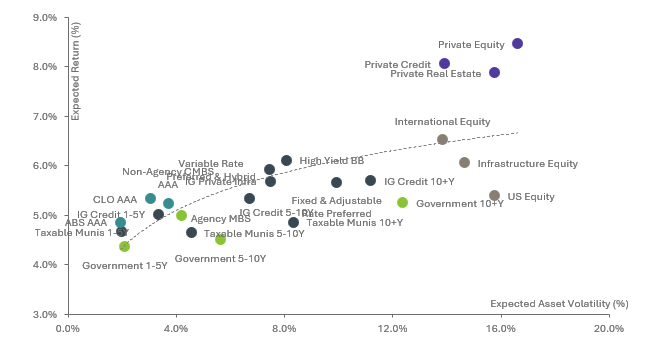
Source: Deutsche Asset Management as of September 2026. Hypothetical based upon assumed market conditions and a 10-year market horizon. Actual market conditions may prove to be materially different. No assurance can be given that any forecast or target will be achieved.
In our view, the next phase of insurance investing may reward “intentional complexity”—structures whose added spread, diversification, or cash-flow fit can be explained and governed, requiring closer integration among investment, actuarial, finance, risk, and regulatory teams.
In our discussions with boards and investment committees, our view on the practical agenda would appear more straightforward:
- Revisit SAA using updated yields and current capital rules rather than previous assumptions
- Evaluate holdings at the security and structure level in order to inform your asset classes, especially in structured and private credit
- Define liquidity as a “resource” to be budgeted across the enterprise
- Measure success against the enterprise objectives and not simply against a peer portfolio or a generic benchmark
Insurance investors currently have more income opportunities. When yield is available across public, structured, and private markets, the competitive advantage comes from knowing what source of yield is worth owning. We believe the general accounts best positioned will not be those that reach furthest but those that convert an opportunity set into resilient income, capital strength, and durable support for policyholders.
*AM Best 2025 STAT Data