New data reveals that reducing preventable risky procedures can measurably lower claim severity in high-risk specialties. This analysis combines results from the MPL Association DataSharing Project—the largest ongoing independent collaborative database of medical professional liability claims and lawsuits—with benchmarking analysis from Preverity, a Sentact company, which aggregates risk by individual procedure.
Analysis of Medical Claims Indemnity
The Data Sharing Project allows the Association to pinpoint where claims originate and analyze specialty-level claim costs. Participants can compare their claims experience with other participants by analyzing claim counts (with or without an indemnity payment), paid indemnity, and defense expenses by specialty. This data allows underwriters to evaluate performance, identify areas where their claims experience differs, and gain insights to support underwriting, claim, and risk management decisions.
Those who manage medical liability risk will not be surprised that the average indemnity payment of obstetrics (Ob/Gyn) surgery claims run 40% higher than average, and almost 80% higher than the lowest, otorhinolaryngology (ear, nose, and throat, also known as ENT).
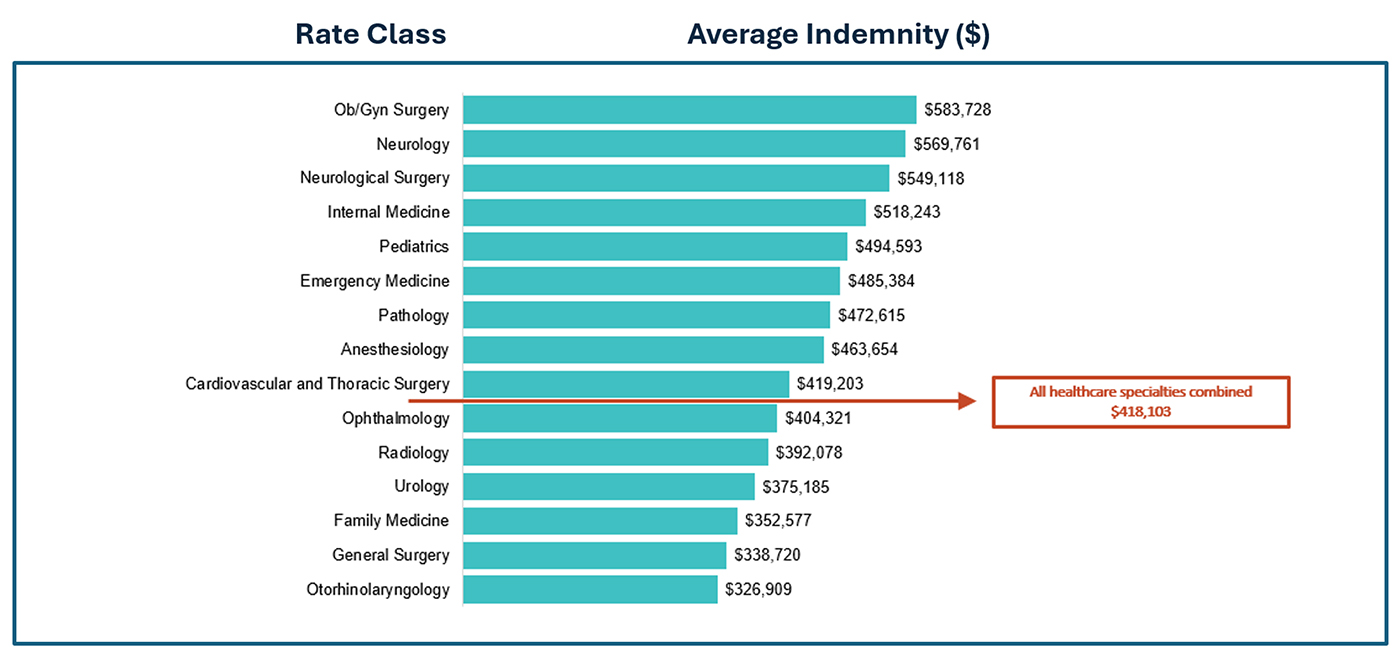
The Top 15 specialties by average indemnity, 2020-2024
How Do Data Sharing Insights Benefit MPL Insurers?
Seeing the differences in average claim severity across organizations is a powerful tool. But how can insurers use this shared data to reduce future claim severity?
Linking industry claims data to specific healthcare practices and procedures can help prevent claims before they start. To advance these efforts, the Association is working with healthcare industry partners to identify patterns and strategies aimed at reducing future claims.
The MPL Association Data Sharing Project matched severity results with physician performance benchmarking data from Sentact, which tracks key hospital and physician measures correlated with safer care. The benchmarking data identifies physicians who are outliers compared with peers and in four areas that correlate with higher claim risk: obstetrics, orthopedics, general surgery, and revision procedures. The result is powerful: MPL risk managers and insurers can identify activities that correlate with claim severity and take targeted actions to address higher-risk behavior. By following the Pareto principle (80% of consequences come from 20% of causes), risk management programs that focus on benchmark outliers are perceived as reasonable and efficient ways to address risk.
How MPL Claims Data and Peer Benchmarking Inform Underwriting for Obstetrics
Obstetric claims illustrate how claims data and peer benchmarking can help MPL insurers identify patterns associated with high severity losses and support underwriting, claims, and risk management decisions. By examining birth trauma rates with MPL claims, insurers can identify physicians with elevated risk indicator and work with healthcare providers to address potential areas of concern.
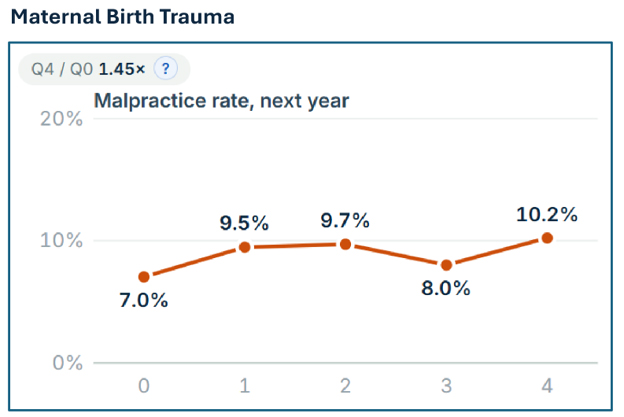
Malpractice frequency generally rises as a provider’s birth trauma rate rises, and the result is statistically significant. While the statistics show an association, not causation, this simple model enables individuals to see which actions correlate with trauma and associated severity. The model surfaces physicians whose actions lead to incidents that strongly correlate with trauma and related claim severity.
Providers with high benchmarks have higher event frequency, and within Ob/Gyn, frequency ties to claim costs. A physician with any birth trauma cases faces up to a 15% higher risk of a malpractice claim; a physician with the highest rate is 45% more likely to face a malpractice claim than a physician with no events. Small differences in the trauma rate at the top of the range have an outsized impact on claims, with 99.9% confidence that the correlation is not random.
Building on Recommendations to Manage Obstetric Risk and Mitigate Claims
A May 2025 Inside Medical Liability Online article, Managing Obstetric Risk to Mitigate Claims, discussed that maternal care is at a turning point. The US has some of the highest rates of maternal morbidity and mortality among developed nations, and complications such as hemorrhage, hypertension, and preeclampsia have driven adverse outcomes up by nearly 200% since 1993. The findings showed that adverse birth outcomes strongly influence the frequency and severity of malpractice claims and that benchmarking physicians against similar providers reveals practice patterns that can be corrected.
We recommended a three-step approach of identifying, discussing, and mitigating risk, built on internal metrics, constructive dialogue with Ob/Gyns, and timely event reporting. One health system that followed this approach cut severe maternal complications by 30% over three years while reducing obstetric MPL claims and reserves.
Partnership Plus Sound Data Can Reduce Losses, Year After Year
Partnership works in insurance. Liability insurers in other industries have shown that ongoing attention to even the smallest safety protocols measurably reduces event severity.
For example, the longstanding partnership between leading construction contractors and the International Risk Management Institute (IRMI) has made large construction sites safer and saved lives. IRMI helps improve construction site safety by providing specialized risk management education, thought leadership, safety data, and operational guidelines for contractors and insurers, according to sources at IRMI and in the construction industry.
Just as the construction industry and insurers learned new ways to save lives and reduce the number of related claim severity, healthcare systems can partner with insurance professionals to reduce unwarranted risk, protect patients, and improve outcomes. IRMI helped transform the construction industry, so the largest building and infrastructure projects in the US now have some of the lowest risk. Just as adopting construction best practices has made work sites safer, enforcing proven protocols has made surgical units safer. MPL underwriters can now access industry data to help their healthcare clients make informed risk-management decisions in the operating room and beyond.